The problem

Approving a network of hundreds of devices row by row does not scale.

Approving them automatically destroys the evidence, because nobody decided anything.

What you see

Bulk sign-off: group, preview, one code, signed entries30 devices selected; 27 signed with one code, 2 held back, 1 left for a person; 27 decision entries plus one batch entry.1 · GroupNeeds decisiongrouped by site and makerBranch 3 · Zebra12HQ · Dell12Branch 3 · HPE630 selectedDecide on all 30Sends the filter, not a list of IDs.2 · Preview the frozen listFrozen listexpires in 15 minutesWill be signedroutine: no warnings27Held backfirst seen under 24 hours2Decide yourselfpossible clone: never in bulk13 · One codeSign 27 approvalsfor Example Community BankReasonFirst baseline, routine devicesAuthenticator code482917Sign 27 decisions4 · Signed entriesAudit logone entry per device, plus the batch#1,204decisionin batch#1,205decisionin batch#1,206decisionin batch… 24 more decision entries#1,231batch_signed27 members · B-7K3M-Q9TXCheckpoint signedBulk sign-off: group, preview, one code, signed entries30 devices selected; 27 signed with one code, 2 held back, 1 left for a person; 27 decision entries plus one batch entry.1 · GroupNeeds decisiongrouped by site and makerBranch 3 · Zebra12HQ · Dell12Branch 3 · HPE630 selectedDecide on all 30Sends the filter, not a list of IDs.2 · Preview the frozen listFrozen listexpires in 15 minutesWill be signedroutine: no warnings27Held backfirst seen under 24 hours2Decide yourselfpossible clone: never in bulk13 · One codeSign 27 approvalsfor Example Community BankReasonFirst baseline, routine devicesAuthenticator code482917Sign 27 decisions4 · Signed entriesAudit logone entry per device, plus the batch#1,204decisionin batch#1,205decisionin batch#1,206decisionin batch… 24 more decision entries#1,231batch_signed27 members · B-7K3M-Q9TXCheckpoint signed
Bulk sign-off. One code signs up to 1,000 decisions. Each device still gets its own signed entry, and risky devices are never proposed.
What this shows

Four steps from left to right. 1, Group: devices that need a decision are grouped by site and maker, and three groups are ticked: Branch 3 Zebra (12), HQ Dell (12) and Branch 3 HPE (6), 30 in all; the bulk bar offers "Decide on all 30". 2, Preview: the list is frozen for 15 minutes and split three ways: 27 will be signed (routine, no warnings), 2 are held back (first seen under 24 hours) and 1 is left to decide yourself (a possible clone, never signed in bulk). 3, One code: "Sign 27 approvals for Example Community Bank" with a reason and a six-digit authenticator code. 4, Signed entries: the audit log gets one decision entry per device (entries 1,204 onward, each marked as in the batch), then entry 1,231, batch_signed, with 27 members and the batch ID B-7K3M-Q9TX, then a signed checkpoint.

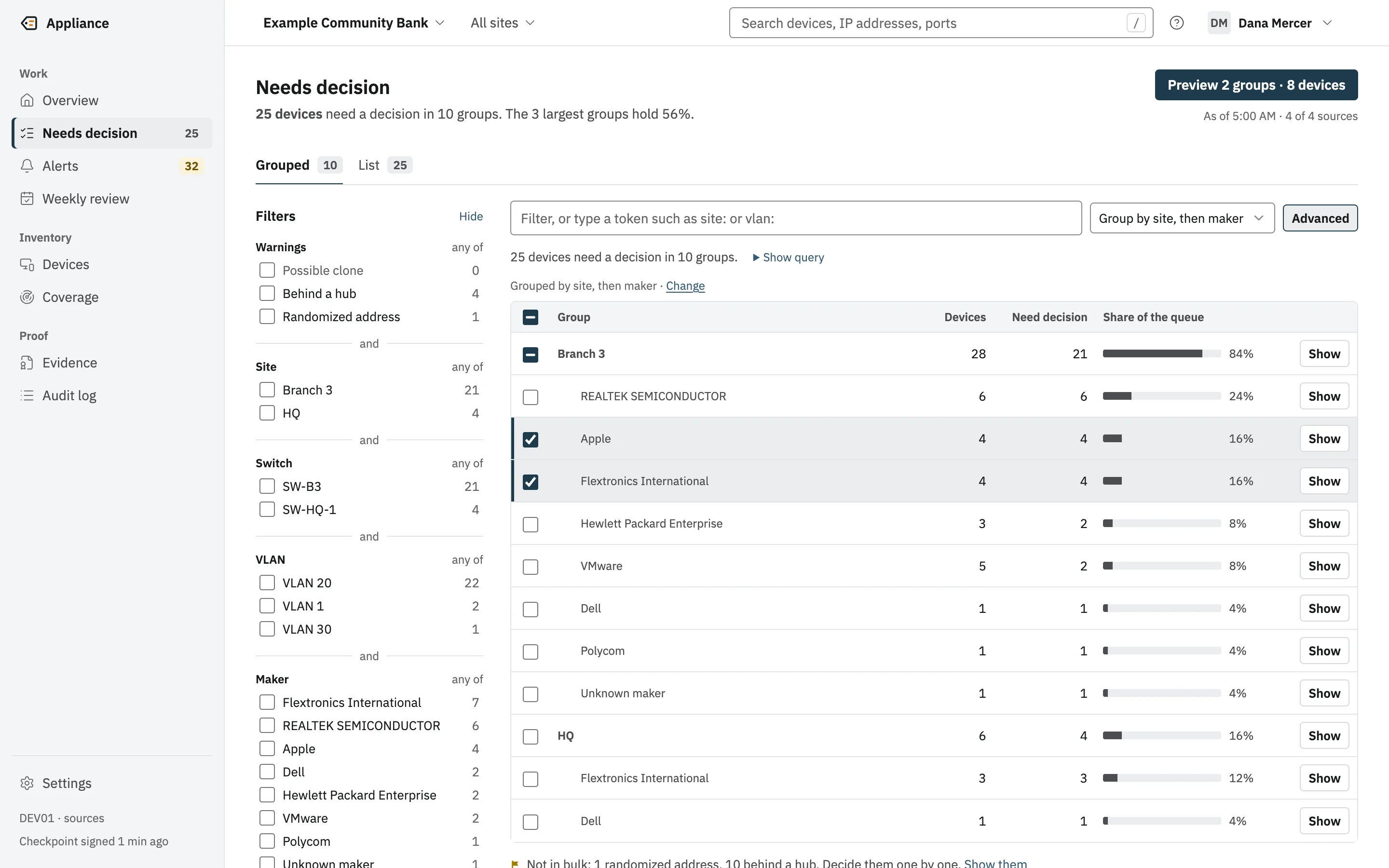
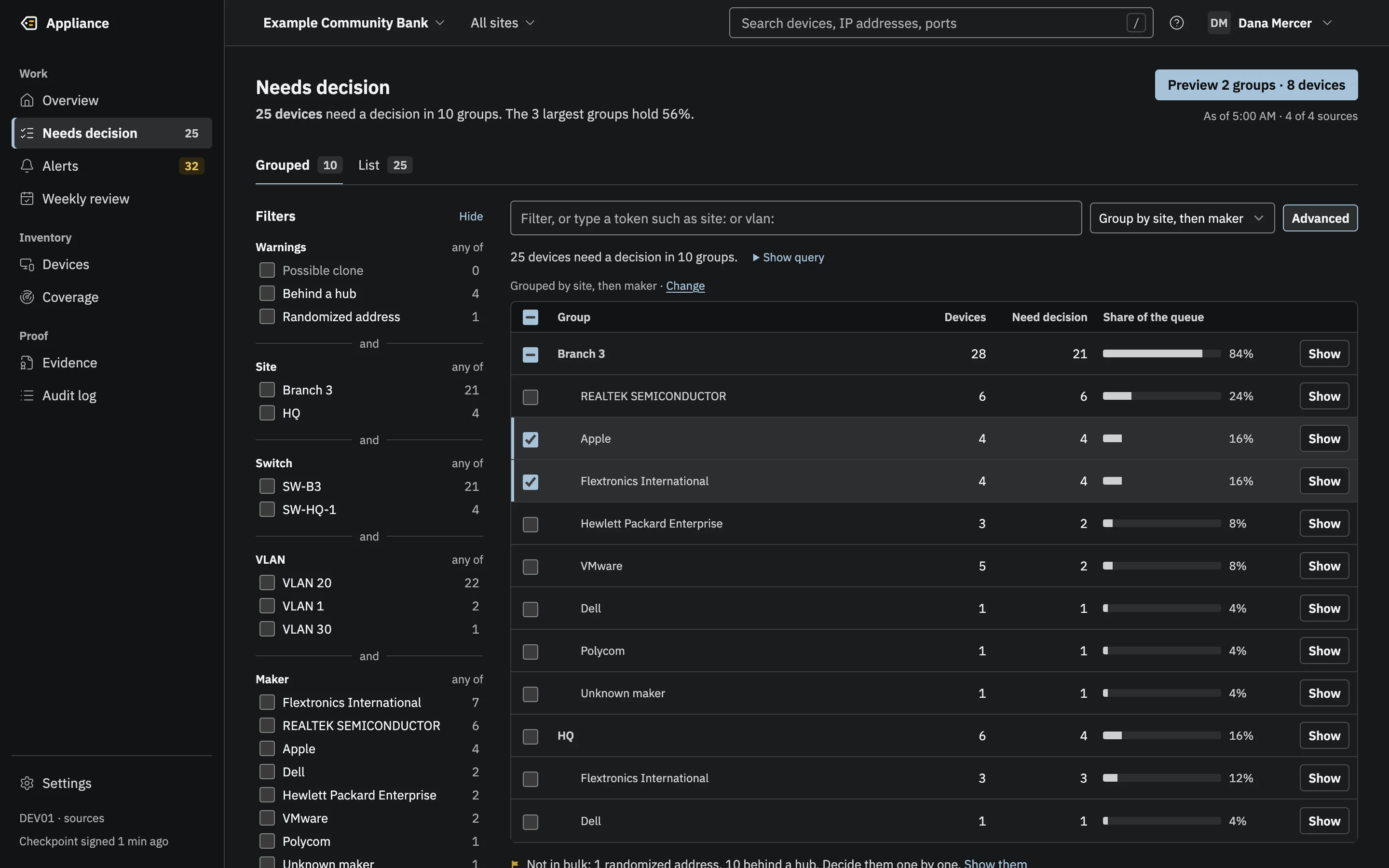
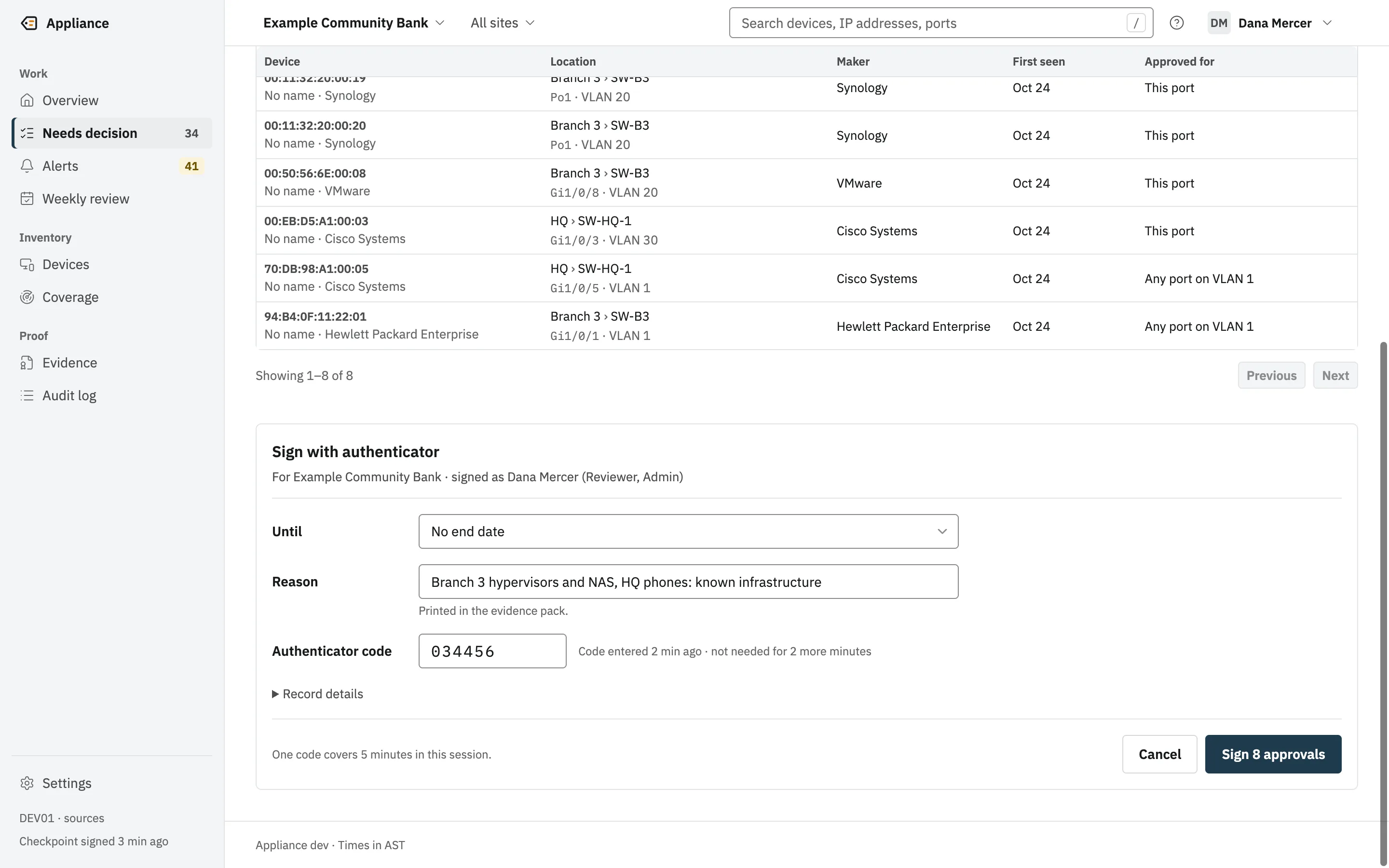
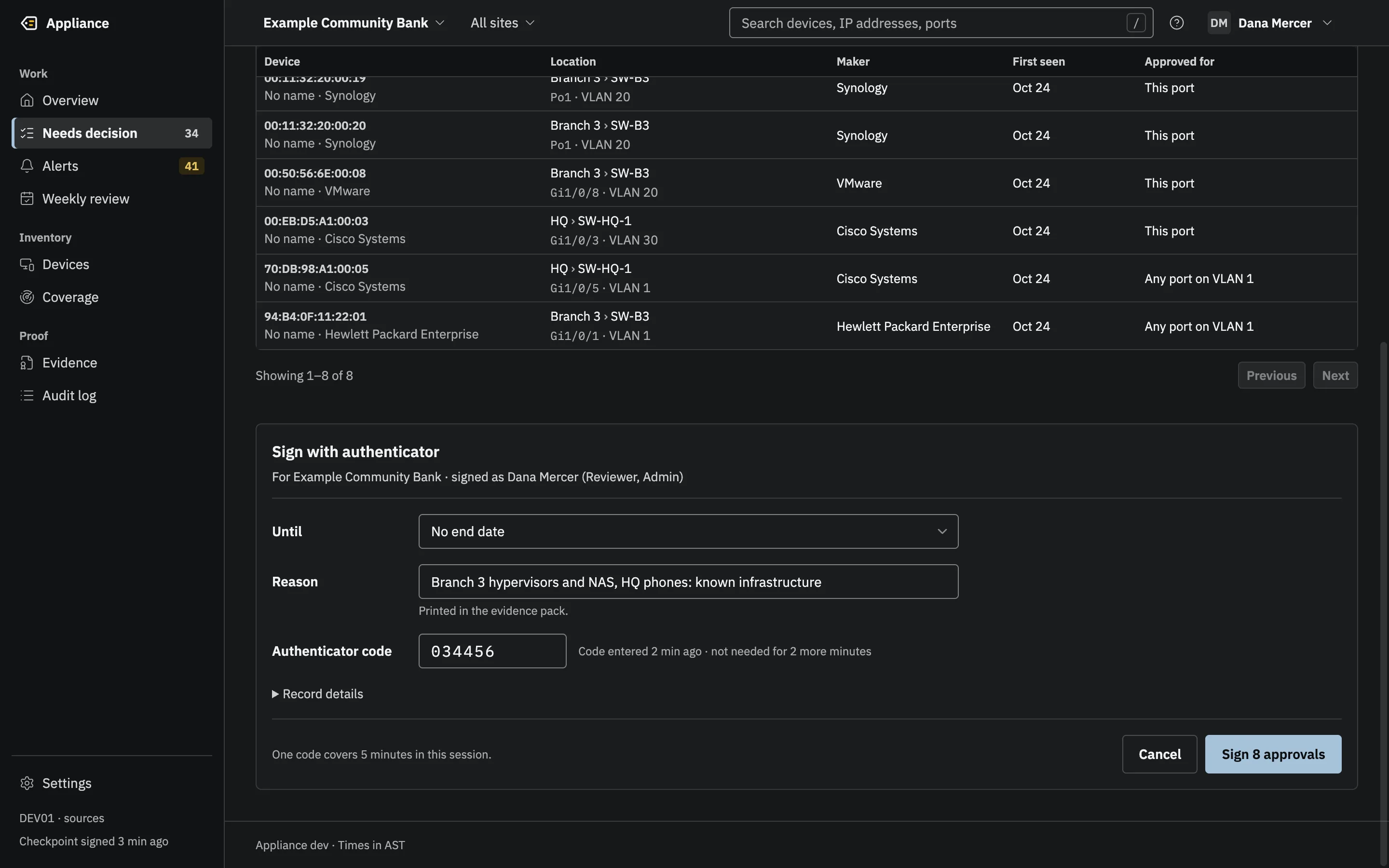
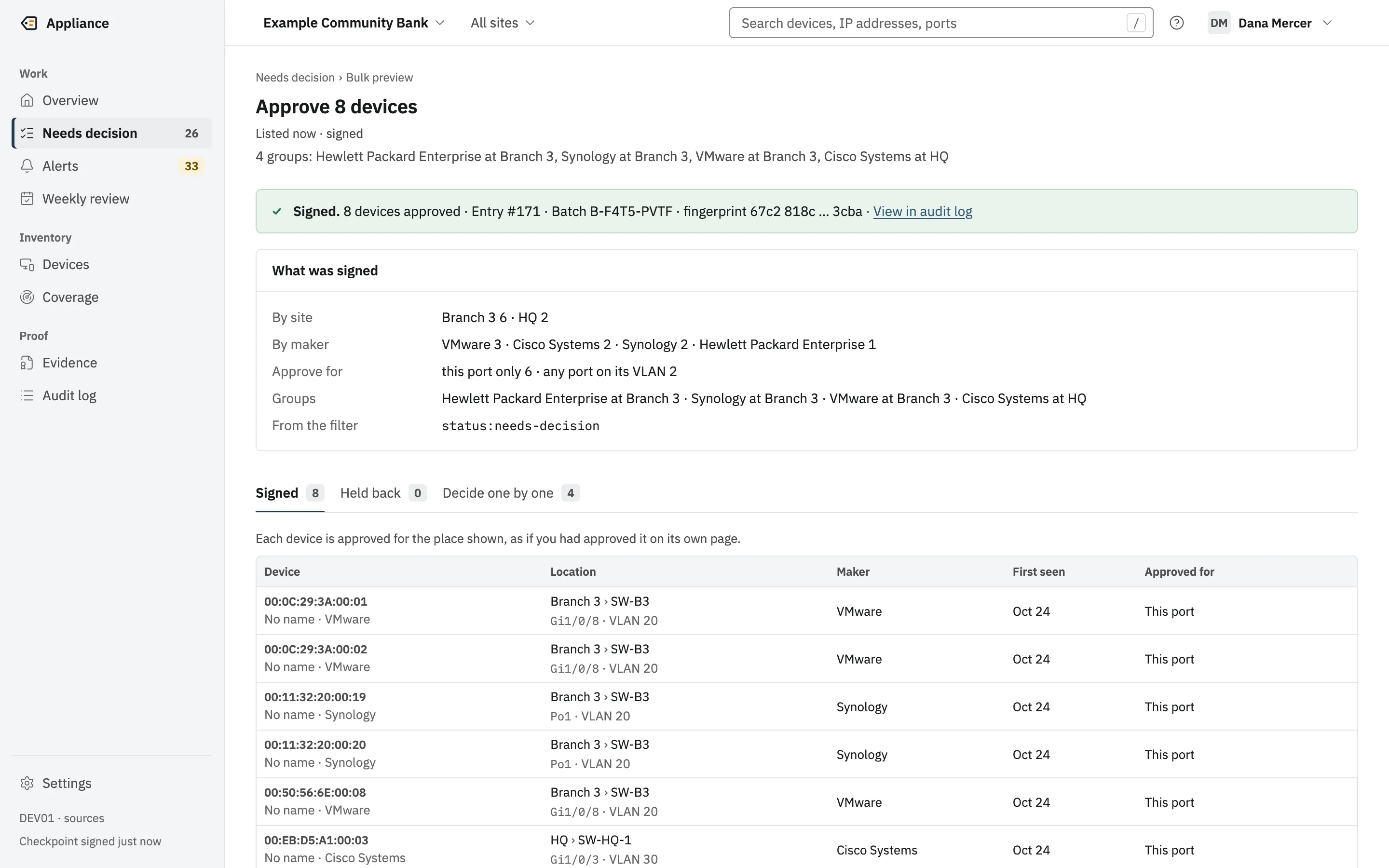
The Needs decision queue grouped by site, then maker: 25 devices in 10 groups, two groups ticked, and a button reading Preview 2 groups, 8 devices. Facet filters sit on the left.(opens the full-size image)The Needs decision queue grouped by site, then maker: 25 devices in 10 groups, two groups ticked, and a button reading Preview 2 groups, 8 devices. Facet filters sit on the left.(opens the full-size image)
Decide by group, not one MAC address at a time.

The Needs decision queue groups devices by site, then maker. Tick the groups you recognize and preview them.

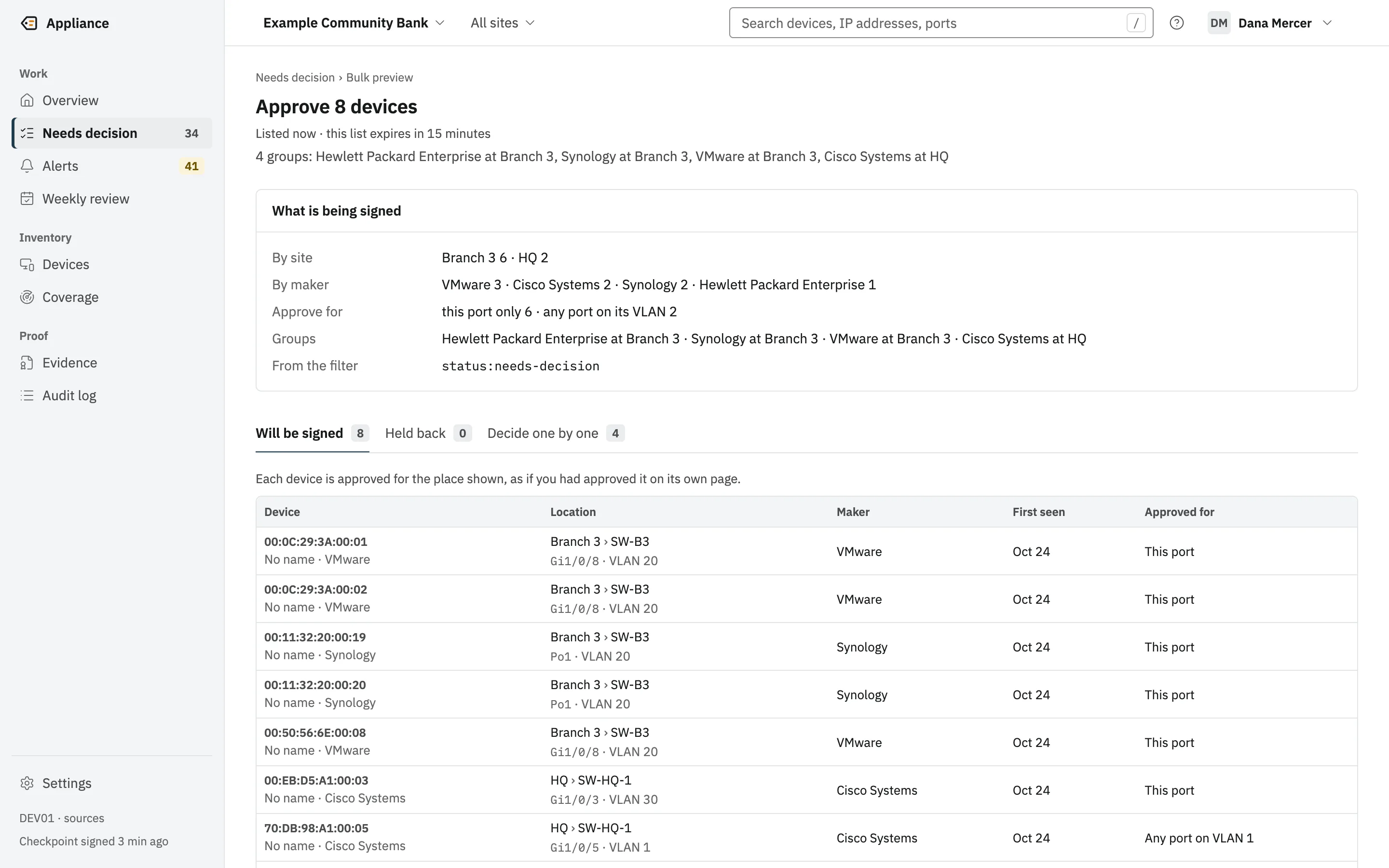
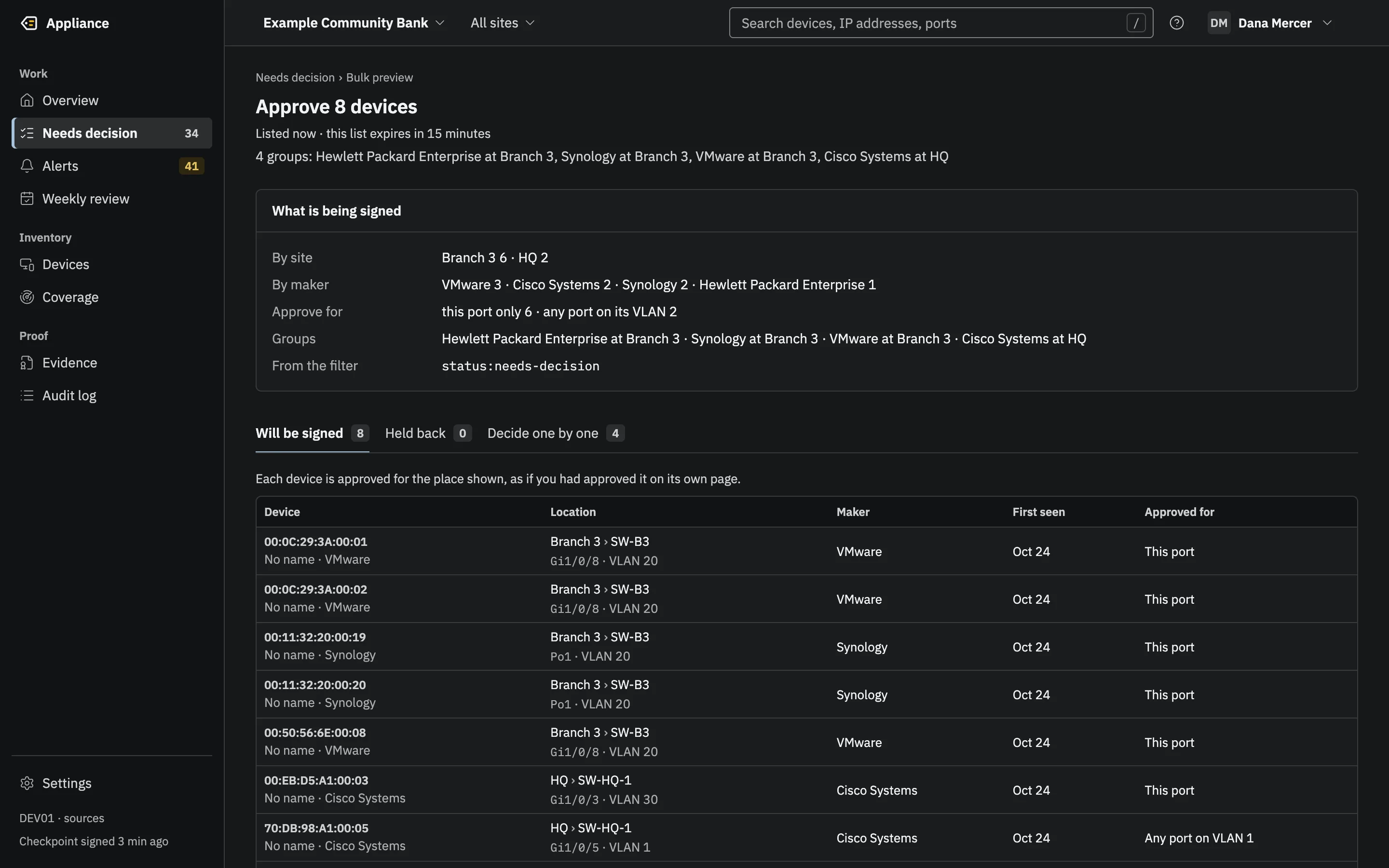
The preview counts what will be signed, what was held back and what you must decide one by one, and it expires in 15 minutes. Sign once with your code, and the result shows the batch ID, the log entry and a fingerprint.

Shown in the new interface, which is in development.

How it works

  • Never proposed for bulk approval: possible clones, location mismatches, randomized addresses, devices not placed on a port, devices on a port with a rogue switch, rogue access point or MAC-flood alert, devices an impersonation alert holds, devices back after an absence, and expired approvals.
  • Held back unless you tick them: devices first seen in the last 24 hours, devices found only by a network scan, and devices with an unknown maker.
  • The preview is stored: exactly the list you saw, with each device’s state. Only you can see or sign it.
  • At signing, each device is checked again. Devices that changed are dropped and reported. If more than 5 devices changed, or more than 5% of the list when that is larger, nothing is signed.
  • Each device gets its own decision entry carrying the batch ID. Then one batch entry binds them with a hash of every member.
  • Signing 1,000 devices took about 0.28 seconds (benchmark on an Apple M4 Pro).

What it proves

The pack builder and the offline verifier check every bulk sign-off against its members: the count, the entries and the members hash. Any mismatch fails the pack as INCONSISTENT. The published specification gives the command to check it by hand.

What it records

Entries this feature writes to the tamper-evident audit log. Each one is in the evidence packs that cover its date.

  • decisionOne per device, each carrying the batch ID and the batch content hash.
  • batch_signedThe count, the member entries, a hash of all members, any devices dropped, the rule, the query, the reason, the reviewer and their roles.
  • checkpoint_signedA signed checkpoint, right after the batch.

Limits

What it does not do yet, stated plainly. The technical page lists every known gap.

  • At most 1,000 devices per batch. Narrow a larger set by site, switch or maker.
  • A guided baseline for day one, accepting thousands of known devices in parts, is built in the new interface, which is in development. On the current release the first baseline is done from the queue with bulk sign-off.

Technical detail

Early access: now taking pilot customers.

See it on your own network.

A live demo with the engineers who built it. We bring a simulated network; you bring your questions.