What we hear

The same few problems, at bank after bank.

Composite situations from conversations with IT and security teams. Not quotes from customers.

  • Exam prepEvery exam, the device list is rebuilt by hand.
  • ApprovalsThe examiner asked who approved a device, and nobody had the answer.
  • NACThe NAC project sits in monitor-only mode, because it kept taking down the phones.
  • StaffTwo people run IT. There is no room for another big project.
  • ScannersThe scanner says the network is clean. Nobody quite believes it.

At exam time

Exam prep becomes an export, not a project.

A detailed inventory, from the switches themselves.

Every device on every polled switch port and firewall, with its site, switch, port, VLAN and maker, re-read every 150 seconds. Not a list someone typed. Printers, cameras and personal devices included, because nothing needs an agent.

Every day, for every source, the inventory also says whether the appliance was actually reading. A day it could not see is printed as “not monitored”.
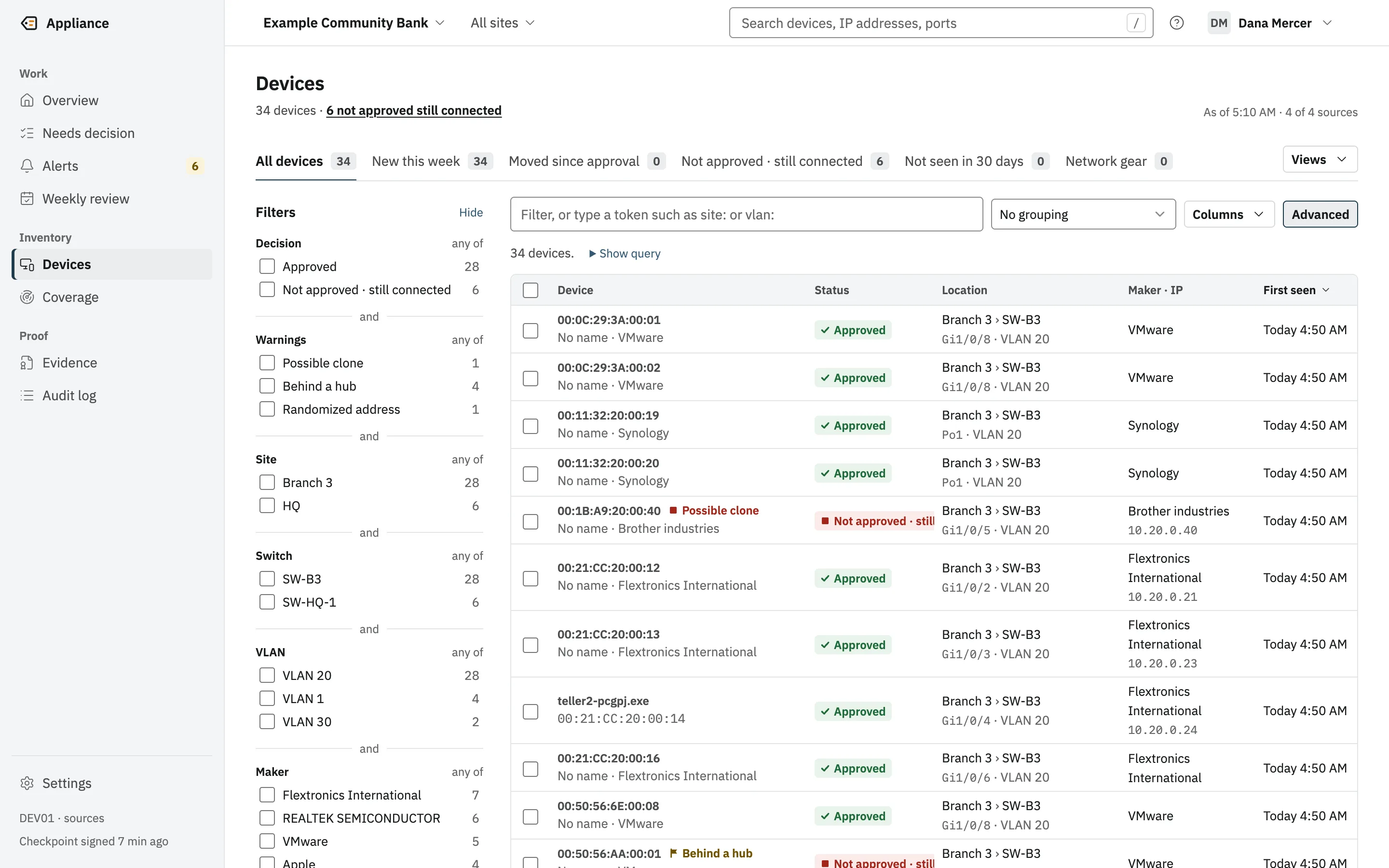
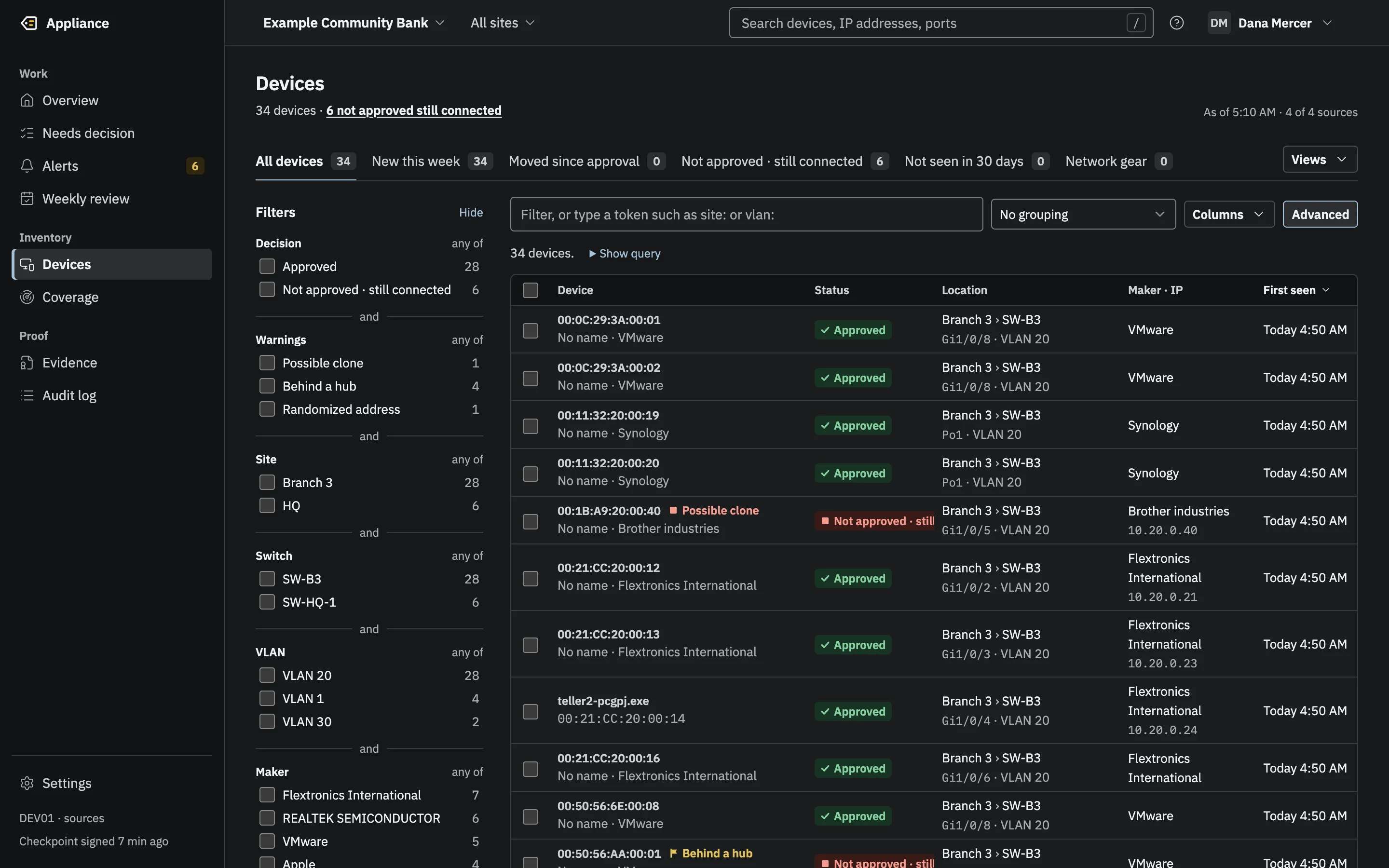
The Devices list: 34 devices with status, location as site, switch, port and VLAN, maker, IP address and first seen.(opens the full-size image)The Devices list: 34 devices with status, location as site, switch, port and VLAN, maker, IP address and first seen.(opens the full-size image)
Every device, with the switch port and VLAN where it is plugged in.

Every unauthorized device dealt with, by a named person.

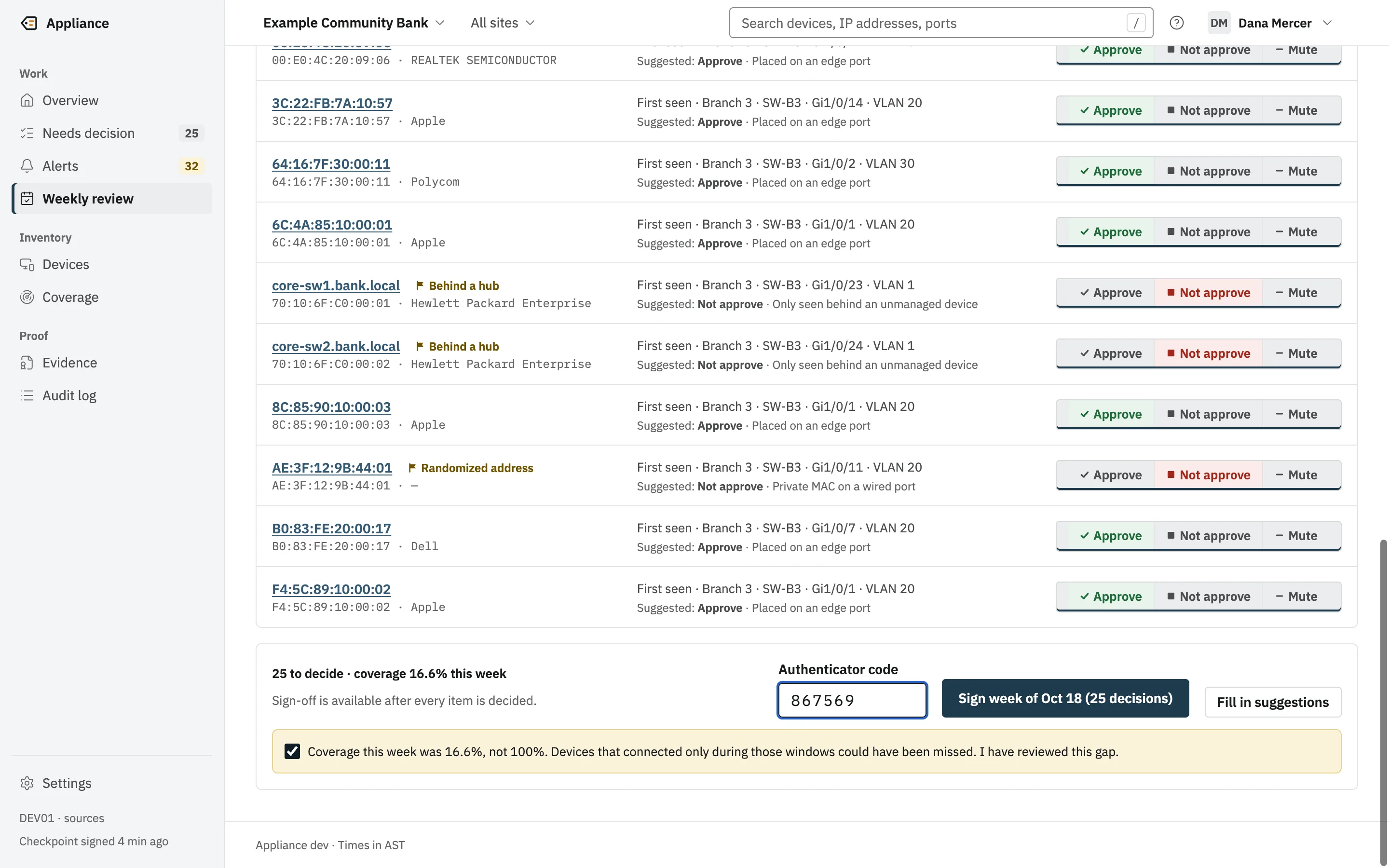
A Reviewer approves or refuses each device with a reason and an authenticator code, and signs a weekly review of everything that changed. A device refused but still plugged in stays on the list until someone removes it.

The person who configures the appliance is not the person who signs. If one person does both, every pack says so.

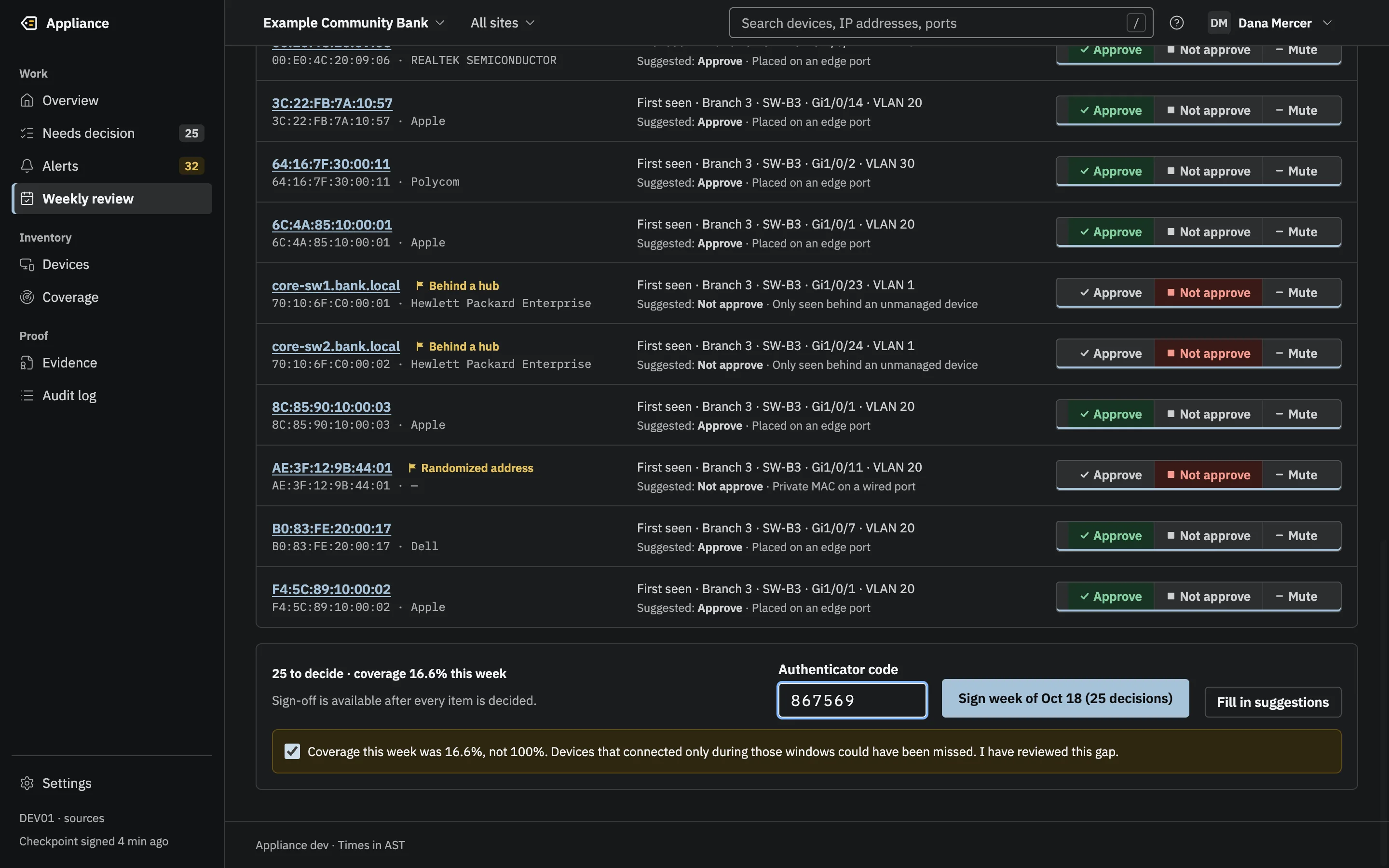
The bottom of the weekly review: a decision chosen for each device, the authenticator code, and a required acknowledgement that coverage this week was not 100%.(opens the full-size image)The bottom of the weekly review: a decision chosen for each device, the authenticator code, and a required acknowledgement that coverage this week was not 100%.(opens the full-size image)
A real screen from a test appliance that started 20 minutes earlier. Coverage reads 16.6% because the days before it count as not monitored, not as clean, and the week cannot be signed until someone acknowledges the gap.

A pack the examiner verifies on their own computer.

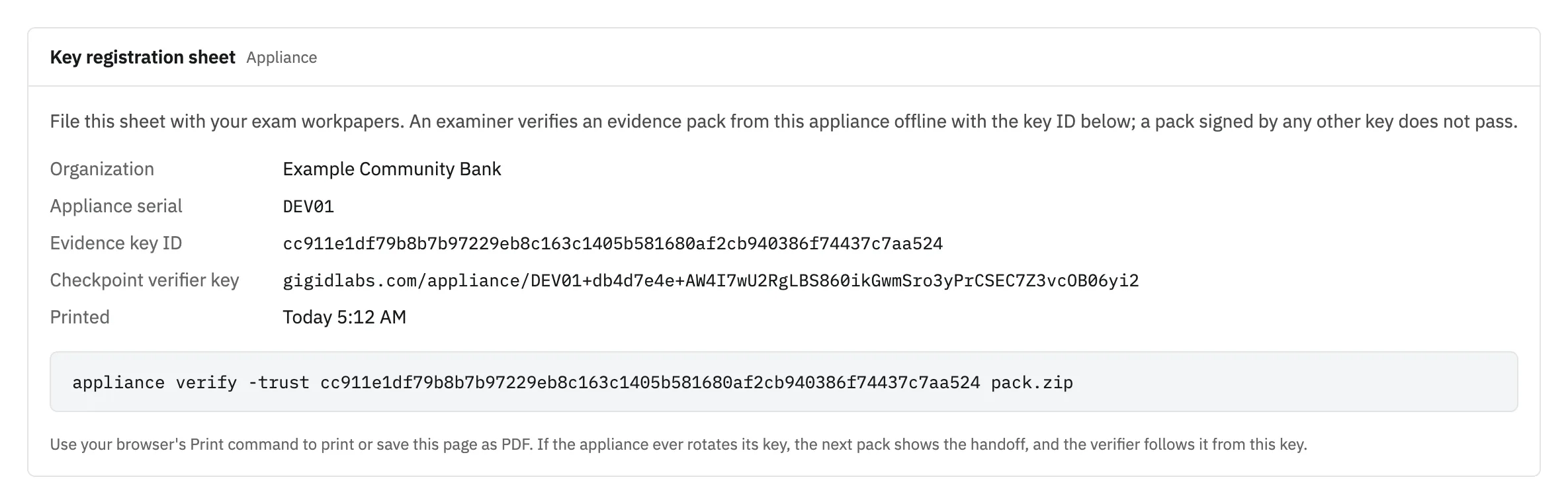
One signed ZIP for the exam period: the inventory, every decision, every weekly review, and every hour a switch was not being read. The examiner runs the verifier, or the published by-hand steps, trusting one key ID from a sheet your ISO signs.

Seven checks, one verdict. A changed file, a missing entry or a rewritten history fails, and the report names it.

The printable key registration sheet: organization, serial, evidence key ID, checkpoint verifier key and the verify command.(opens the full-size image)
Print the key sheet once and file it with your exam workpapers.

Give your examiner a sign-in of their own.

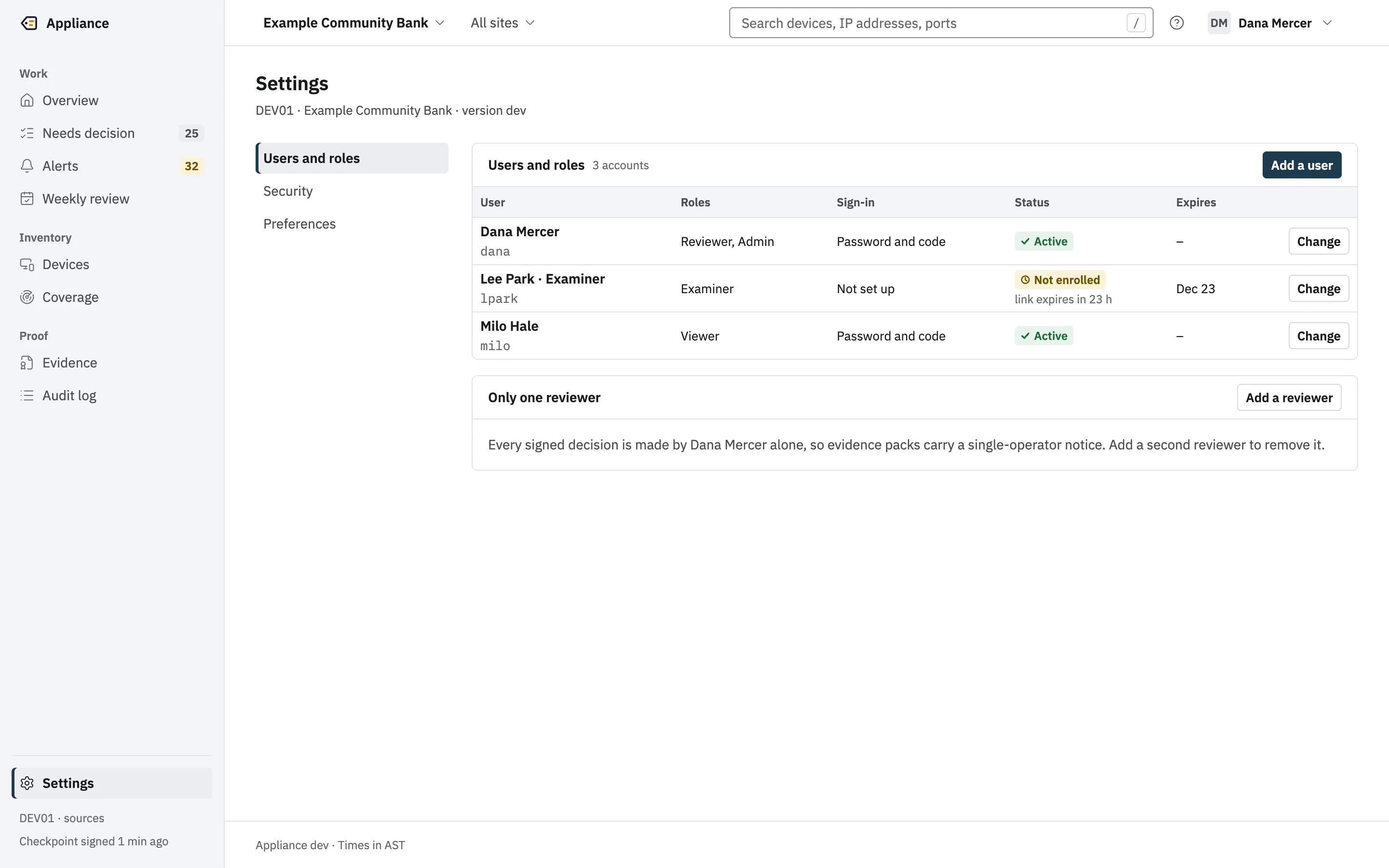
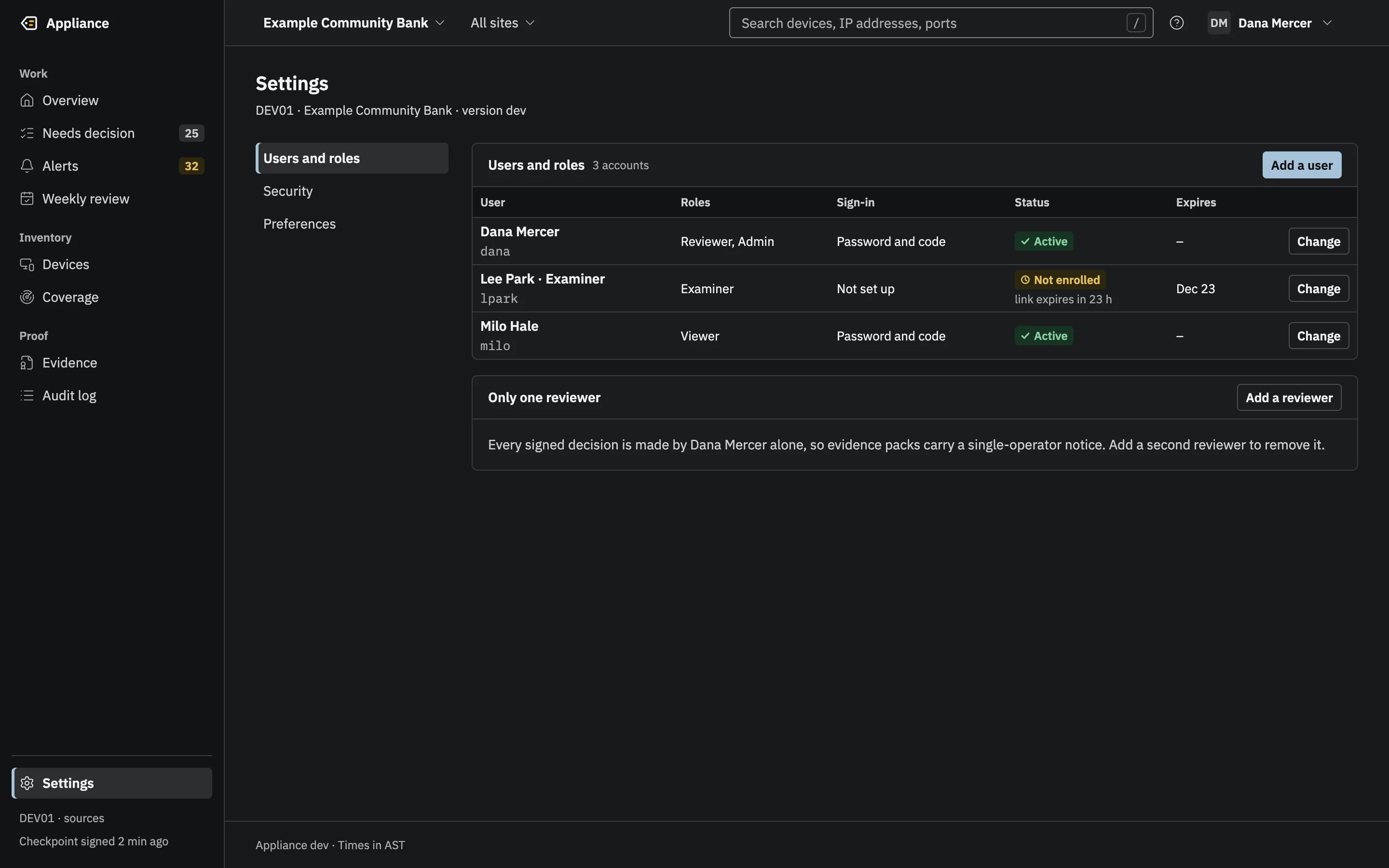
The Examiner role is read-only: the same screens your team uses, plus exports and the list of integrations, so they see everything that leaves the box. It cannot approve or change anything.

An Examiner account always has an end date, set when the Admin adds it. Every sign-in is in the audit log.

Users and roles: a Reviewer and Admin, a time-limited examiner account not yet enrolled, a Viewer, and an Only one reviewer notice.(opens the full-size image)Users and roles: a Reviewer and Admin, a time-limited examiner account not yet enrolled, a Viewer, and an Only one reviewer notice.(opens the full-size image)
Time-limited examiner accounts, and a clear notice when one person does everything.

Frameworks

Mapped to CIS Controls v8.1 Control 1, with status shown as it is.

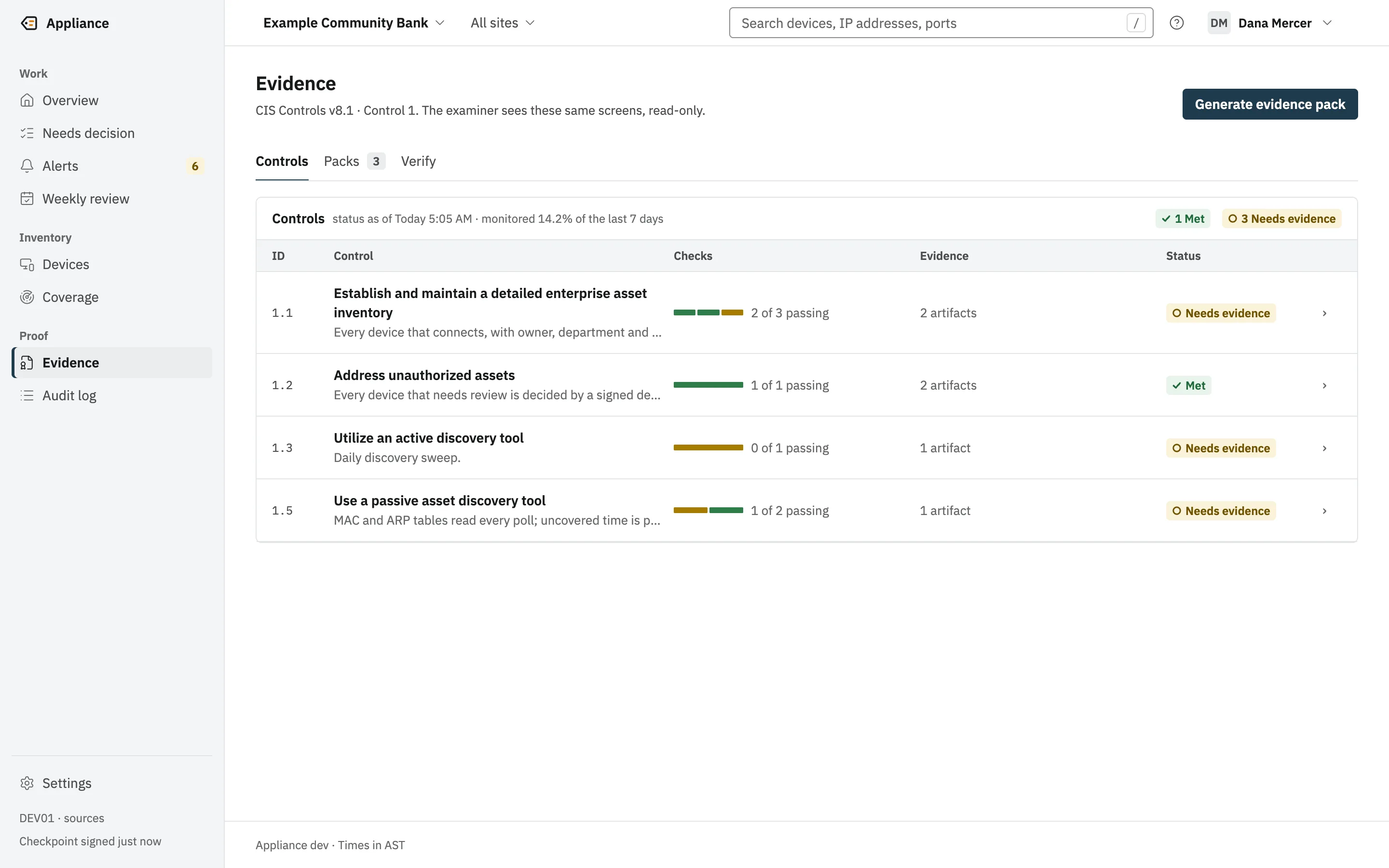
Safeguards 1.1 (asset inventory), 1.2 (address unauthorized assets) and 1.5 (passive discovery) show their evidence in the product, each with its checks and the pack files that prove it, and Met only when the data is there. Safeguard 1.3 (active discovery) is not claimed: it shows Needs evidence, because it is not built. Safeguard 1.1 also needs an owner for each approved device; owner editing is in development, so 1.1 shows the gap until then.

Every pack prints the frameworks its controls view refers to:

CIS Controls v8.1 / NIST CSF 2.0 / 12 CFR 30 App. B, 364 App. B, 748 App. A

That line is a label, not a mapping document. It supports your program with evidence. It does not replace it.

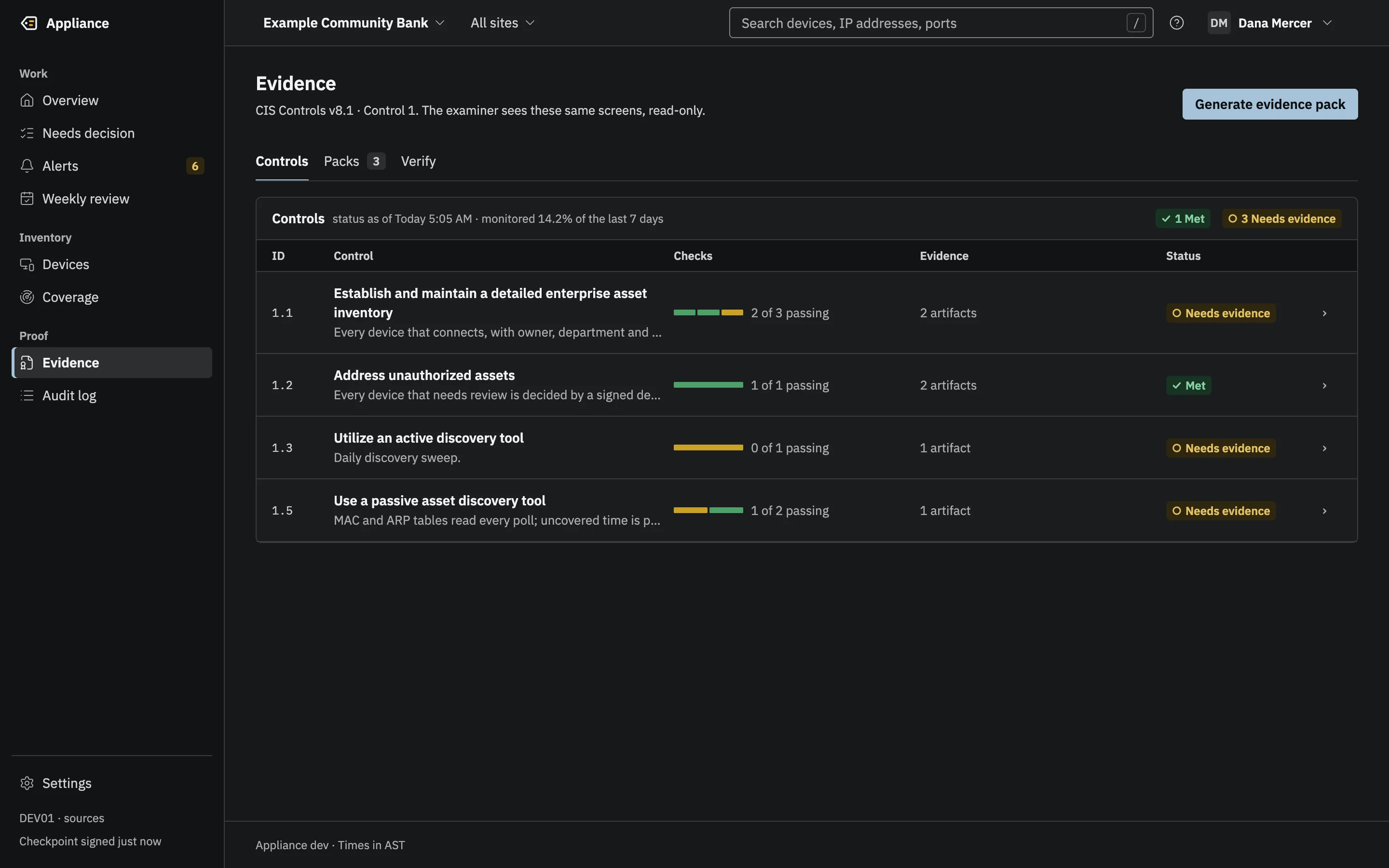
The same controls view after the weekly review: safeguard 1.2 is met; three still need evidence.(opens the full-size image)The same controls view after the weekly review: safeguard 1.2 is met; three still need evidence.(opens the full-size image)
Status changes only when the evidence is there.

For the board

A quarterly report whose numbers can be checked.

Enter the targets your board approved, such as deciding on every new device within two business days. The appliance measures every case against them from the signed log: time to detect, time to decision, coverage and reviews on time.

The signed board report carries the evidence pack for the same quarter. The verifier recomputes every figure, and a number that does not follow from the log fails.

Your policy, measured: a policy target over a quarter, and the signed board reportA policy target measured week by week from the signed log: 41 of 42 cases met. The signed board report verifies as PASS; a changed copy fails as NUMBERS DIFFER.Signed logthe only inputdevice_first_seenalert_raiseddecisionconfig_changeThe CLI on a copy of thedatabase and the offlineverifier get the same numbers.Policy IT-07 §4.2 · Q3Decide on new devices within 2 business daysdecide_new_device · weekends and holidays count nothingJulAugSepall meta miss41 of 42 cases metTarget not metJudged on exact counts; the miss links to its log entries.Time to decisionmedian 5 h 12 m90th percentile 1 d 9 hTime to detectmedian 2 m 31 ssighting to alertBoard report2026-Q3Example Community Bankevidence packSigned, with:figures as JSON and CSVone row per casethe evidence packproofs for each entryreport-verify board-report.zipPASSa copy with one figure changedNUMBERS DIFFERYour policy, measured: a policy target over a quarter, and the signed board reportA policy target measured week by week from the signed log: 41 of 42 cases met. The signed board report verifies as PASS; a changed copy fails as NUMBERS DIFFER.Measured from the signed log, and nothing else.Policy IT-07 §4.2 · Q3Decide on new devices within2 business daysdecide_new_deviceJulAugSep41 of 42 metTarget not metOn exact counts. The miss links to its entries.Time to decisionmedian 5 h 12 m90th percentile 1 d 9 hTime to detectmedian 2 m 31 sBoard report2026-Q3Example Community Bankevidence packSigned, with:figures as JSON and CSVone row per casethe evidence packproofs for each entryreport-verify board-report.zipPASSa copy with one figure changedNUMBERS DIFFER
Your policy, measured. Every figure is computed from the signed log, and the report verifier computes it again. Illustration with fictional figures.
What this shows

Every figure comes from one input, the signed audit log: device sightings, alerts, decisions and each saved version of the policy. One policy target, from a fictional policy section IT-07 4.2: decide on new devices within 2 business days. Week by week over the third quarter, every case was decided in time except one, in the seventh week, so 41 of 42 cases met the target and the target is not met; pass or fail is decided on exact counts. Time to decision had a median of 5 hours 12 minutes and a 90th percentile of 1 day 9 hours, and the slowest case links to its log entries. Time to detect had a median of 2 minutes 31 seconds. Beside it, the board report for the quarter, a signed file with the figures as JSON and CSV, one row per case, the evidence pack for the same quarter and the proofs. The report verifier checks the signature and computes every figure again: the signed report prints PASS, and a copy with one figure changed prints NUMBERS DIFFER. All figures are fictional.

Vendor management

What your vendor review will want to know.

Read-only by construction, SNMPv3 with SHA-256 and AES-128, no inbound internet access, and an authenticator code on every sign-in. We also list what we have not done yet: no third-party penetration test and no SOC 2 report so far.

  • Never writes to your network.

    SNMP GET, GETNEXT and GETBULK only. It never changes a switch. When a port should be shut, the alert prints the command for a person to run.

  • Never talks to GigID Labs.

    No telemetry, no license check, no update check, no vendor endpoint. Destinations under gigidlabs.com are refused.

  • Never sends your data to an AI service.

    Device data leaves only for destinations an Admin configures: your SIEM, chat, ticketing or mail relay.

  • Never approves a device on its own.

    Every device on a monitored jack waits for a person’s decision, including the box someone plugs in to run their own AI. Imported lists and rules never approve anything.

Read the security pageFor technical buyersWhat we have not done yetTalk to us about a vendor review

What buyers ask us first.

Cost

Prices are not on this site yet; ask us, and we will answer in writing. What it needs from you is small: it runs on a server or VM you already have and reads the switches you already own, with no database to license and no per-endpoint agents.

How much work it is

A guided setup, and a live test for each switch that names the fix if something is wrong. After the first baseline, the routine is a weekly review of what changed.

If you already have NAC

Keep it. NAC enforces at the port. The appliance shows what is actually on the wire, including what NAC let through or what sits on monitor-only ports, and keeps the signed record of who approved each device. It never blocks, so it cannot cause an outage.

If you already have an RMM

An RMM sees computers with its agent. Printers, cameras, phones and vendor kit have none; the switch sees all of them. The appliance also reports to your RMM through exit codes.

Who we are

Engineers first, each with more than 20 years in the field, who kept seeing this gap and built the tool we wanted. We are in early access with pilot customers. We will show you the product live, answer your vendor review in writing, and tell you what it does not do yet. More about us

Also for

  • MSPs

    One appliance per client, wired into the tools you already run.

    • Tickets in ConnectWise, Autotask, HaloPSA or ServiceNow
    • The evidence log in your SIEM
    • Exit codes for your RMM
  • Small and mid-size businesses

    Know every device on your network without a security team.

    • Runs on hardware you already have
    • Plain-English alerts
    • No agents on your computers

Early access: now taking pilot customers.

See it before your next exam.

A live demo on a simulated branch network, with the engineers who built it. Bring the questions your examiner asked last time.